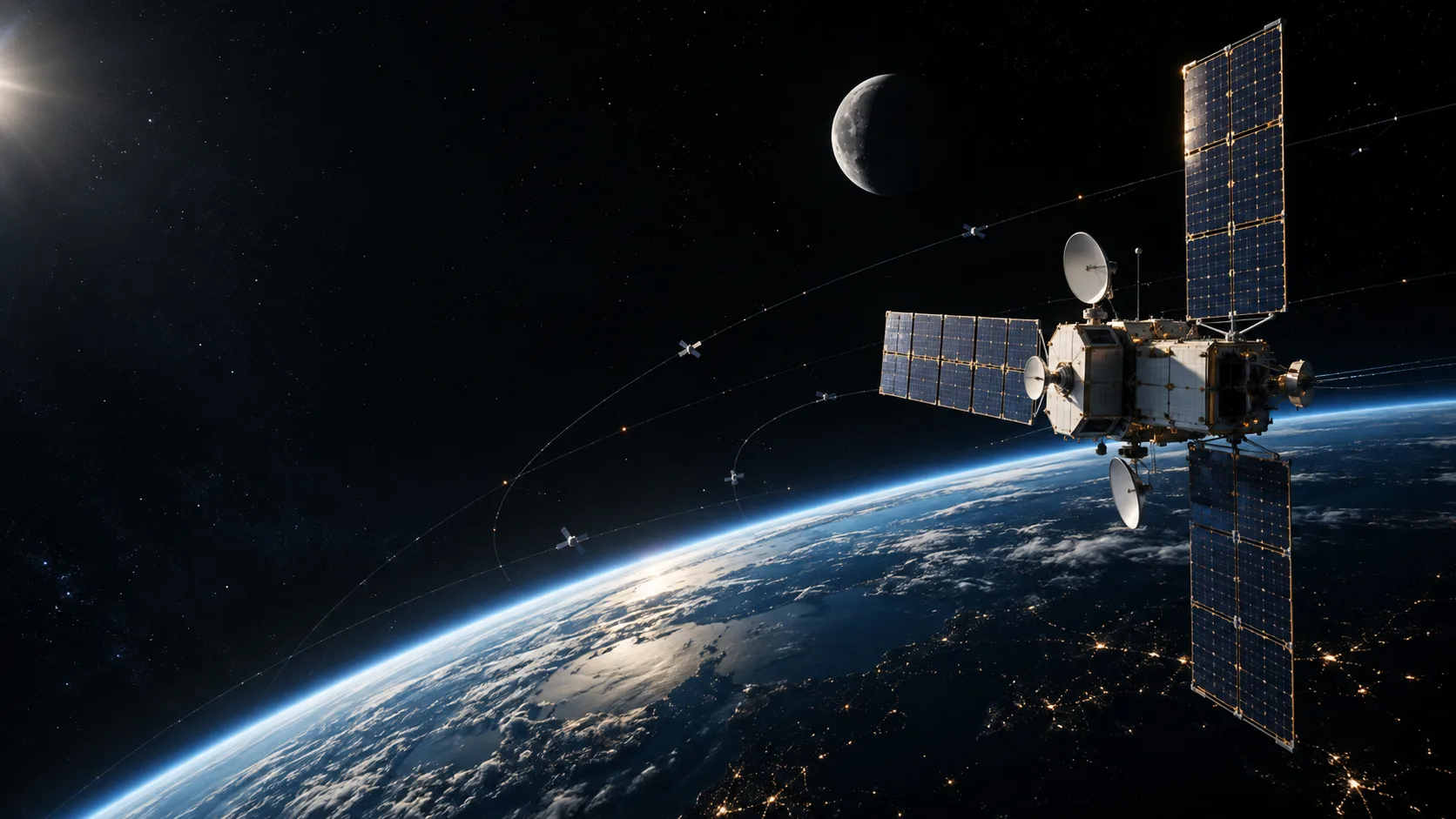
For most of the space age, a lunar mission was an expedition: build a vehicle, plant an instrument, survive long enough to return a result. In 2026 the governing idea is different. The Moon is being treated as a place where services must persist — communications, navigation, power, landing capacity, logistics and eventually maintenance.
NASA’s Artemis II carried four astronauts around the Moon from April 1 to April 10, 2026. The flight matters beyond its nine days because it exercised the human-rated transport layer: Orion, the Space Launch System and the ground systems intended to support a sequence of missions. NASA’s February architecture update added another mission and now describes Artemis III as a 2027 low-Earth-orbit demonstration of one or both commercial lunar landers, with Artemis IV targeting a lunar landing in early 2028.
Two architectures, one bottleneck
China’s program approaches the same problem through robotics. CNSA has described Chang’e 7 as a south-pole campaign designed to investigate terrain, volatiles and water ice, with international instruments aboard. Chang’e 8 is intended to test resource-use technologies and help form the basis of an International Lunar Research Station. Different political systems and mission sequences still meet the same engineering constraint: a useful lunar presence needs dependable infrastructure between Earth and the surface.
The decisive lunar product may not be a lander. It may be the service that tells every lander where it is, keeps it powered through darkness, and returns its data.
Europe, Japan and India are not merely supporting characters. ESA provides major Orion hardware and is developing communications, navigation and cargo capabilities. Japan’s strength in sample return and precision robotics is visible in the MMX mission to Phobos. India’s NISAR partnership with NASA demonstrates how a national agency can turn a difficult shared spacecraft into a global data utility.
What becomes a market
The near-term market is not lunar tourism. It is institutional demand broken into repeatable contracts: delivery by kilogram, relay by gigabyte, power by kilowatt-hour, mapping by square kilometre and risk reduction by successful demonstration. Companies that can sell a service to several programs have a better business than those tied to one heroic mission.
This changes how to read launch announcements. A mission should be judged not only by whether it flies, but by what reusable layer it leaves behind. A relay satellite, common docking interface or interoperable navigation signal can compound in value. A one-off payload often cannot.
The uncertainty
Schedules remain fluid. NASA’s architecture has changed repeatedly, and China publishes less operational detail in English than the United States or Europe. Treat dates beyond the next launch as targets, not appointments. The strategic direction, however, is unusually consistent: governments want a durable route outward, and industry is being asked to turn that ambition into services.
Sources
- NASA, “Artemis II,” updated July 7, 2026.
- NASA, “NASA Adds Mission to Artemis Lunar Program, Updates Architecture,” February 27, 2026.
- CNSA, “China’s Chang’e-7 lunar mission to carry instruments developed through international cooperation,” April 26, 2024.
- CNSA, “China’s Space Program: A 2021 Perspective.”