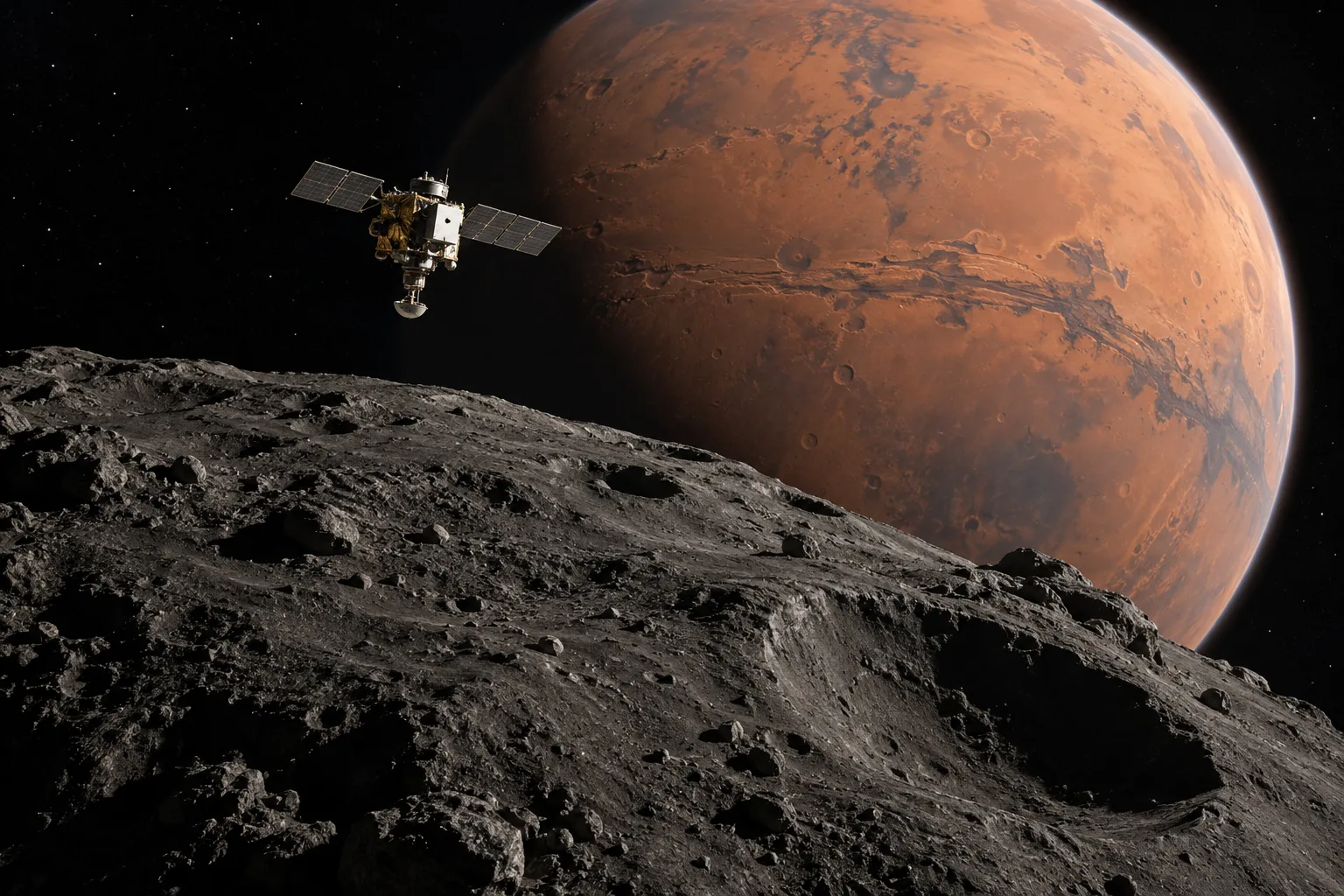
On October 20, 2026 at 04:41:03 Japan Standard Time, JAXA plans to launch the Martian Moons eXploration mission aboard an H3 rocket from Tanegashima. MMX will travel for roughly a year, spend about three years studying the Martian system and attempt to return more than 10 grams of material from Phobos to Earth in fiscal year 2031.
The mass is tiny. The strategic payload is not. No mission has returned material from the Mars system. If MMX succeeds, laboratories can test competing stories of how Phobos and Deimos formed: captured asteroids, or debris assembled after a giant impact on Mars.
A mission assembled across borders
JAXA leads, but the instrument list reveals a deliberate international design. NASA, France’s CNES, Germany’s DLR and ESA contribute hardware and expertise. The IDEFIX rover developed by CNES and DLR will survey Phobos ahead of the main spacecraft’s landing and sampling attempt. Remote-sensing instruments will help select a site before the sampler touches the surface.
That collaboration is not diplomatic garnish. It distributes technical risk and gives each partner access to a scientifically rare target. It also makes MMX a template for middle-power leadership: own the mission architecture, invite specific world-class contributions and make the returned sample a shared scientific asset.
H3 is part of the experiment
The launcher is inseparable from the mission. Japan’s H3 program suffered a failure on its eighth flight in December 2025 and JAXA established a special task force. MMX therefore arrives with unusually visible launch risk. Success would strengthen both planetary science and confidence in Japan’s sovereign launch chain; delay would ripple through a narrow interplanetary window.
MMX turns ten grams of rock into a test of an entire national capability: launch, autonomous operations, precision landing, sampling, planetary protection and return.
The most useful way to follow MMX is by milestones, not spectacle: launch readiness, Mars arrival, mapping, rover deployment, landing-site selection, sampling, Earth departure and capsule recovery in Australia. Each milestone proves a capability that can be reused.
Sources
- JAXA MMX Project, “Martian Moons eXploration,” launch notice dated August 20, 2026.
- JAXA MMX Project, “Mission Overview / Mission Flow.”
- JAXA, H3 Launch Vehicle press releases, including December 2025 and March 2026 updates.