A rocket earns revenue when it flies. A useful satellite service can earn revenue every day. This difference explains why the quieter layers of the space economy — terminals, ground stations, mission software, data processing, cyber security and regulatory operations — deserve more attention than launch spectacle suggests.
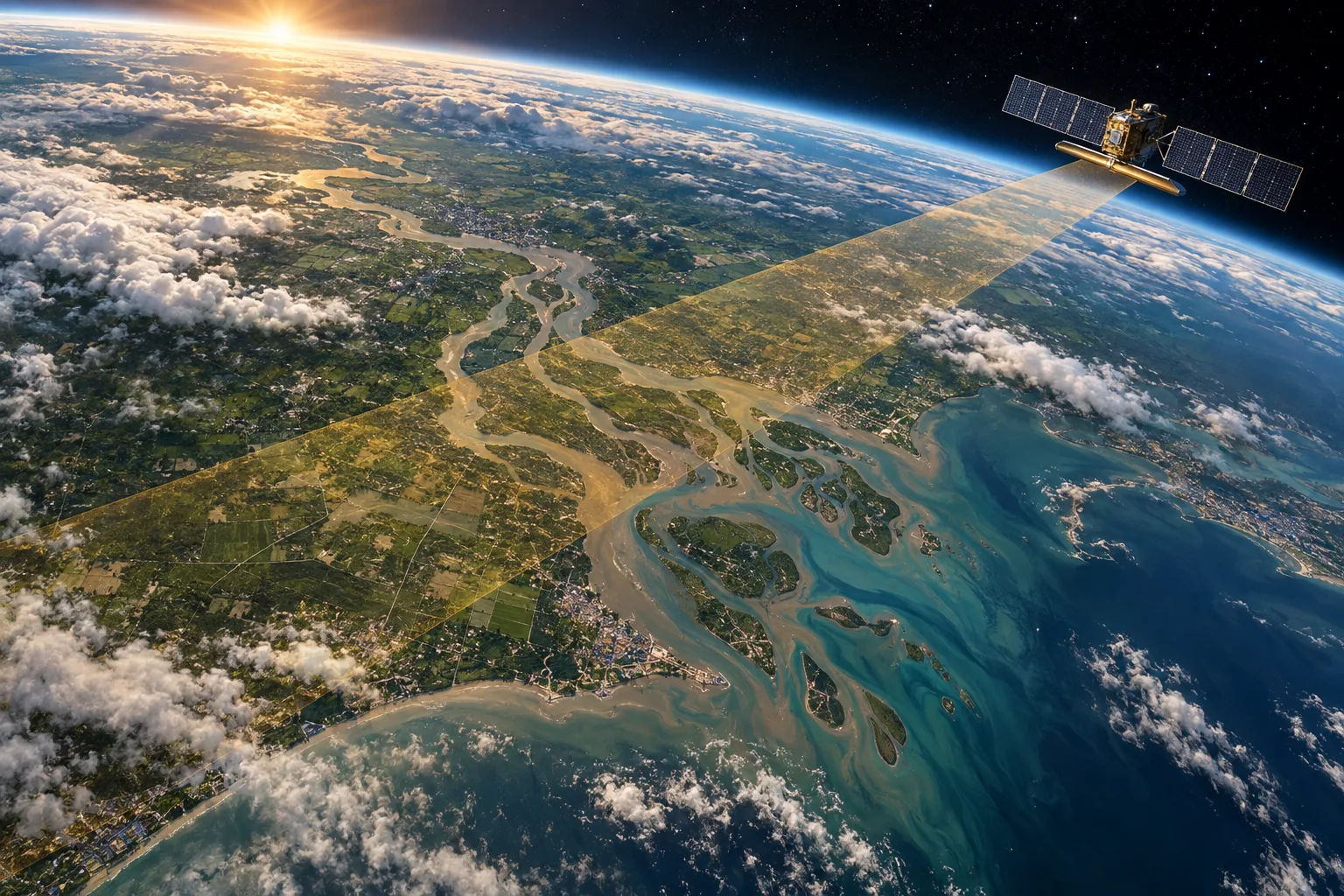
ESA’s Space Economy work tracks both upstream manufacturing and downstream services because public investment creates value through use. The satellite that maps a flood is upstream hardware; the decision system that routes emergency crews is the product experienced on Earth.
Recurring pain creates recurring revenue
Operators continually schedule contacts, process telemetry, screen conjunctions, manage spectrum, patch software and deliver data. As the number of functioning spacecraft rises, those jobs scale even when launch prices fall. ESA’s July 2026 statistics estimated about 16,000 functioning satellites, a large installed base requiring operations and risk management.
Ground businesses can also be multi-constellation. A neutral antenna network, security layer or geospatial analytics platform may serve several missions and customer sectors. That diversification is harder for hardware designed around a single launch or one spacecraft bus.
The moat is workflow, not access
Raw satellite data is becoming more abundant. Advantage shifts to calibration, trusted models, integration with customer systems and evidence that an output improves a decision. NISAR’s open radar products, for example, create room for services in soil moisture, infrastructure deformation and hazard monitoring. Access is the beginning; local validation and operational delivery are the moat.
The strongest space company can look like an ordinary software or services company whose indispensable input happens to arrive from orbit.
Investors and customers should ask four questions: does the product solve a recurring task; can it work across missions; is distribution secured; and does regulation strengthen or constrain the model? A spectacular demonstration answers none of them alone.
Sources
- ESA, Space Economy Portal and 2026 report, June 2026.
- ESA Space Debris Office, Space Environment Statistics, July 31, 2026.
- ISRO, NISAR S-Band data release, July 24, 2026.