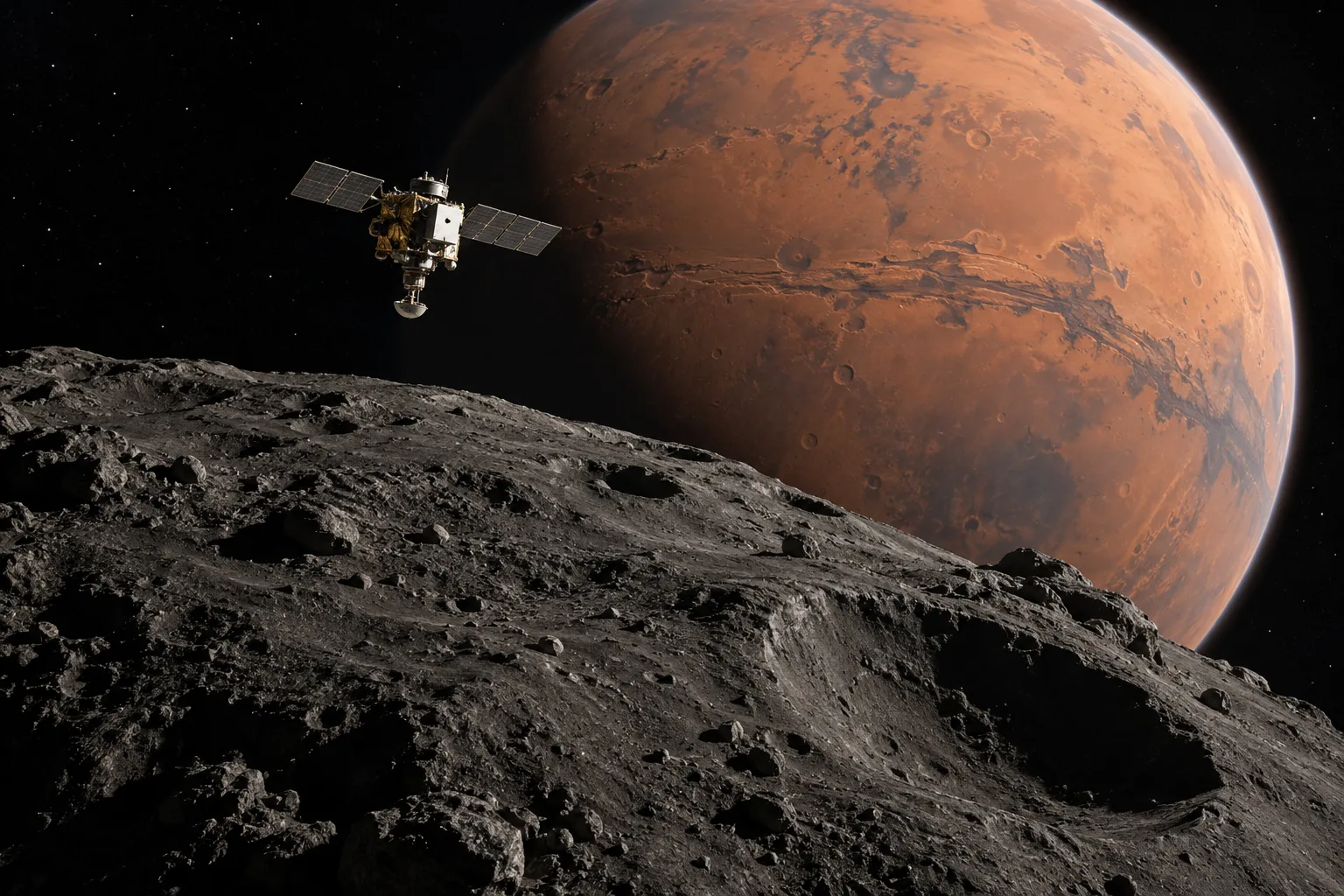
China’s Chang’e 7 mission is designed around the lunar south pole, where permanently shadowed terrain may preserve water ice and other volatiles. CNSA’s published plan describes an orbiter, lander, rover and a small craft able to investigate shadowed areas — a system built to approach several scientific and operational problems at once.
The mission’s international instruments include contributions associated with Egypt, Bahrain, Italy, Russia, Switzerland, Thailand and the International Lunar Observatory Association. Planned measurements range from hyperspectral imaging and radiation balance to lunar dust, electric fields and space weather.
Why the architecture matters
Polar exploration punishes a single-vehicle design. Terrain blocks line of sight, temperature and illumination vary sharply, and the coldest targets are the hardest to reach. An orbiter can relay and map; a lander provides a stable platform; a rover covers useful ground; a hopper can attempt the final approach into a shadowed site.
CNSA has linked Chang’e 7 and Chang’e 8 to a basic model of the International Lunar Research Station. Chang’e 8 is expected to emphasize resource-use experiments. Read together, the missions suggest a progression from finding and characterising resources to testing whether any can support operations.
The strategic prize is not the announcement of lunar water. It is a repeatable way to locate, reach, measure and eventually use it.
How to read limited visibility
China’s English-language public information is less granular and less continuously updated than NASA’s. This makes precision essential. Official pages have used “around 2026” for Chang’e 7, while a March 2026 CNSA meeting in Chinese discussed progress, risks and mission execution without supplying a public launch date. The defensible statement is that the campaign is advancing; a specific date should wait for a formal launch notice.
For global partners and competitors, the key signal is the chain. Queqiao relay infrastructure, Chang’e sample returns, south-pole survey and later resource experiments form a capability stack. Each mission reduces uncertainty for the next.
Sources
- CNSA, “China’s Chang’e-7 lunar mission to carry instruments developed through international cooperation,” April 26, 2024.
- CNSA, “China’s Space Program: A 2021 Perspective.”
- CNSA, Chang’e 7 mission leadership meeting, March 12, 2026 (Chinese).